 how-to
How to Create a Cozy Reading Nook: 7-Step Guide
Table of Contents
- Start With the Space: How to Create a Cozy Reading Nook in Any Corner
- Small Reading Nook Ideas That Use Unused Corners
- Reading Nook Essentials: Seating, Storage, and Soft Furnishings
- Reading Nook Lighting Ideas for Day and Night
- Renter-Friendly Reading Nook Setups You Can Take With You
- How to Create a Cozy Reading Nook on a Budget: Three Tiers
- Comfort and Ergonomics: What People Forget When Building a Book Nook
- Conclusion
- Frequently Asked Questions
Last Updated: October 21, 2026
Start With the Space: How to Create a Cozy Reading Nook in Any Corner
A comfortable chair, one good lamp, and a corner you actually use: that is the whole recipe.
You do not need a spare room. You need about one square metre you already own.
The nook works best when it feels enclosed. A corner gives you two walls. A window seat gives you one wall and a view. Even the dead space beside a wardrobe can hold a chair and a lamp if you plan it first.
Measure First, Shop Second
The biggest mistake is buying the chair before you know the footprint. Most people do it backwards.
Grab a tape measure and note three numbers:
- Wall length from corner to door or furniture
- Depth you can spare, usually 80-100 cm for a chair plus legroom
- Height to the nearest socket or window sill
Write them down. Take the paper shopping.
A chair needs roughly 70 cm of width and 80 cm of depth. Add 40 cm in front for your legs. If your corner is smaller than that, a floor cushion or a slim bench will fit where an armchair will not.
Small Reading Nook Ideas That Use Unused Corners
The best small reading nook ideas turn space you already ignore into the most-used seat in the house. Look for spots that hold nothing: the strip beside a bookshelf, the landing at the top of the stairs, the gap between a bed and a window. The trick is to measure the footprint before you fall in love with a chair, because each awkward space has its own minimum clearance.
Under-Stairs, Window Seat, and Bedroom Corner Options
Each awkward space takes a different setup, and the numbers matter more than the styling:
- Under the stairs: low headroom suits a floor cushion and a low shelf. You need at least 90 cm of headroom at the seat and 60 cm of depth for a cushion plus legroom. Add a wall light, since a floor lamp will not fit and a table lamp will be knocked over. A shallow 20 cm shelf mounted at skirting height keeps books off the floor without stealing sitting room.
- Window seat: build or buy a bench with storage inside. A comfortable seat depth is 45-50 cm, and the bench should sit 40-45 cm off the floor so your feet rest flat. Cushions on top, books below. If the window is draughty, a bench with a solid back panel blocks more cold than an open frame.
- Bedroom corner: a slim chair angled at 45 degrees feels intentional and needs only about 70 cm of wall. A round side table 40-45 cm across fits tighter than a square one because it has no corners to catch a shin. Leave 75 cm between the chair and the bed so you can walk past.
Renters, skip built-ins. A bench you can move beats a window seat you cannot take with you. And before you buy anything, mask the footprint on the floor with painter's tape and live with it for a day, it is the fastest way to see whether the corner actually has room for the chair you want.
Reading Nook Essentials: Seating, Storage, and Soft Furnishings
Every reading nook essentials list starts with the chair, because everything else supports it. Choose seating you can sit in for an hour without shifting.
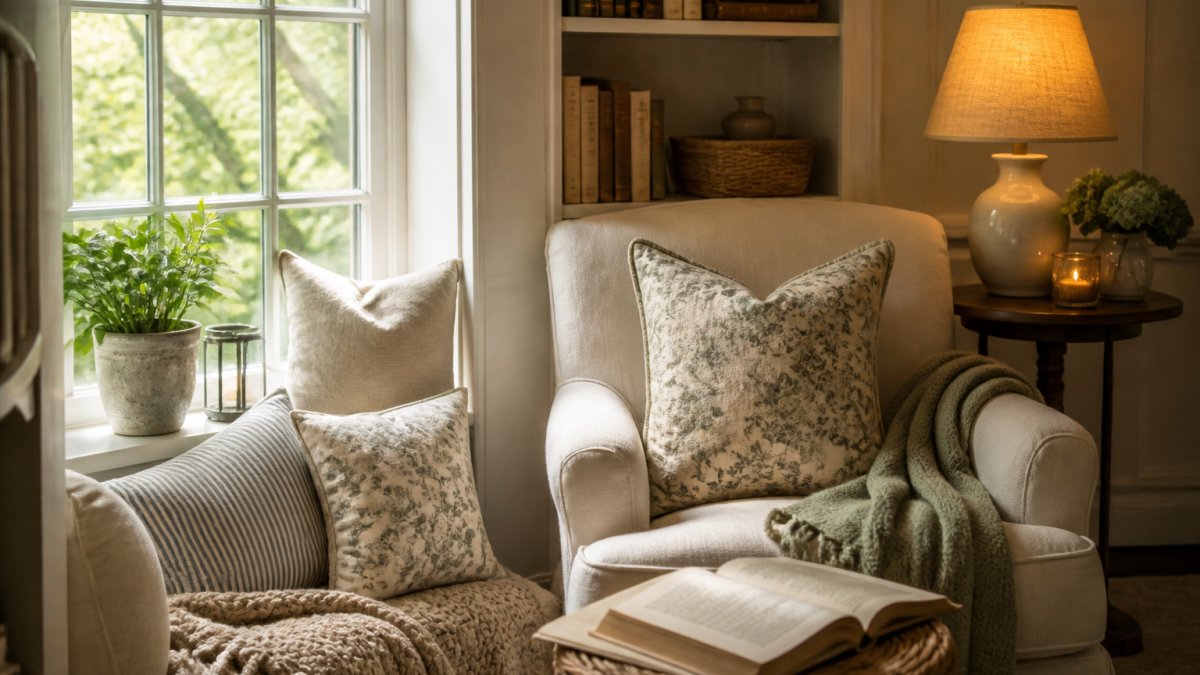
Seating options, ranked by space:
- Armchair with a high back, best for long reads
- Wingback for draughts and privacy
- Bench or window seat for shared use
- Floor cushion or beanbag for tight corners
- Hanging chair only if the ceiling joist is sound
Storage comes next. A small side table holds a drink, glasses, and the book you are mid-way through.
Then the layers. This is where a plain corner becomes a room. Cushions soften a hard chair back. A throw adds warmth and colour.
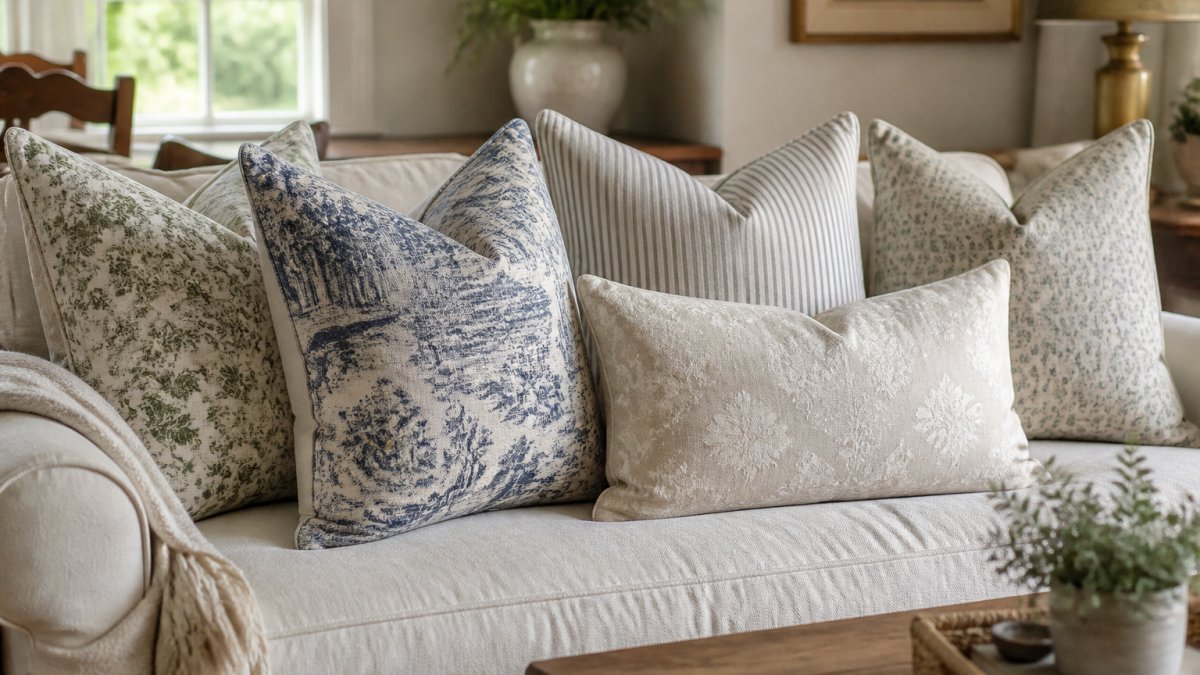
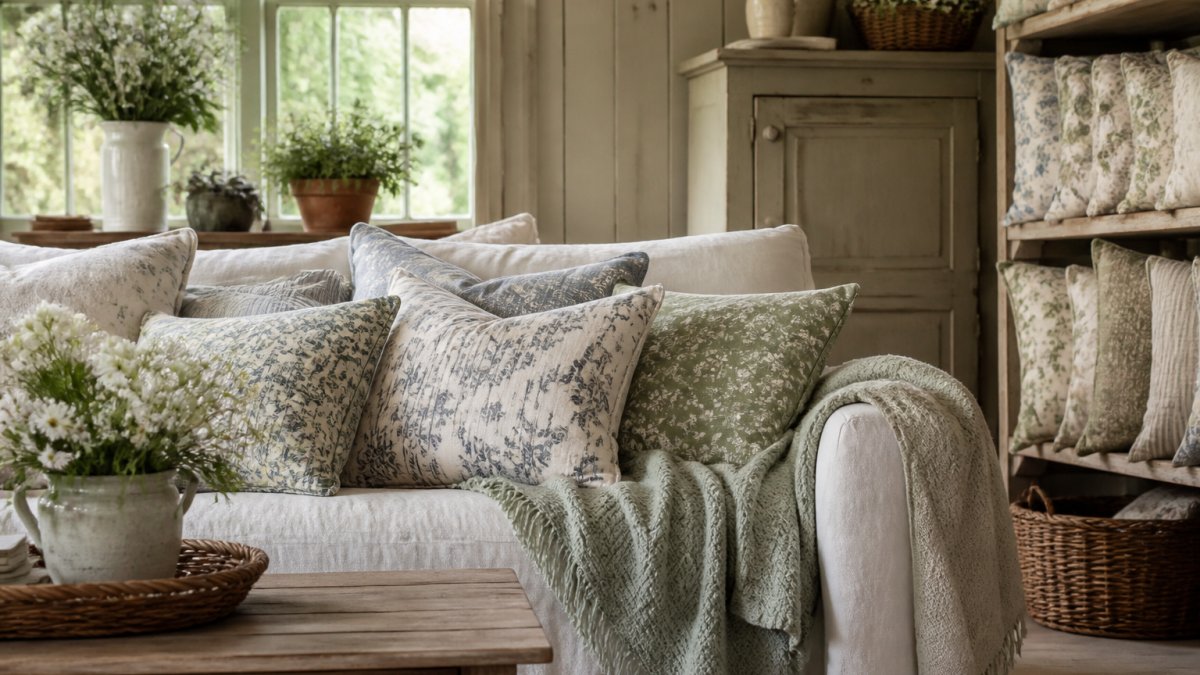
Mix patterns with one rule: keep the scale different. Ivy & Linen's mix-and-match pillow covers are built for exactly this, with floral block prints, toile, ticking stripes, and woven damask designed to sit together.
Reading Nook Lighting Ideas for Day and Night
Good reading nook lighting ideas solve two problems at once: seeing the page without glare, and making the corner feel warm after dark. Plan for both, and plan the numbers, most lighting advice stops at "add a lamp," which is why so many nooks end up either dim or harsh.
Daylight: Position, Not Just Presence
Put the chair side-on to the window, never facing it. Facing a bright window tires your eyes within minutes because your pupil constricts against the bright background while the page stays in shadow. Side light falls across the page instead. If the only spot faces the window, a sheer curtain or a light diffusing blind takes the edge off without blocking the view.
Evening: Two Layers, With Heights
For evening, you need two layers, and each has a placement rule:
- Task light: a floor lamp or wall light with the shade at shoulder height when seated, roughly 100-110 cm from the floor for an average adult. The shade should sit slightly below eye level so the bulb is not in your line of sight, and the light should fall over the page, not behind your head.
- Ambient light: a small table lamp or a warm bulb elsewhere in the room, so the contrast between the lit page and the dark room is not harsh. A single bright task light in a dark room makes the page readable but the room uncomfortable; the ambient layer is what makes the corner feel cosy rather than clinical.
An adjustable task lamp, one with a swing arm or a tilting shade, is worth the upgrade because you can move the pool of light as your reading position changes. A fixed floor lamp locks you into one chair angle.
Bulb and Brightness Specifics
Check the bulb, not just the fixture. A warm white bulb around 2700K keeps the corner soft; cool white bulbs at 4000K and above read as office lighting and undercut the whole point of a cosy nook. For brightness, a task light in the 400-600 lumen range is usually enough for reading a paperback at arm's length; a dimmer or a lower-lumen bulb is better for the ambient layer so the two layers stay distinct.
Renter-Friendly Reading Nook Setups You Can Take With You
Renter-friendly reading nook setups rely on furniture that moves and fixes that leave no holes. No drilling, no built-ins, no repainting.
What works:
- Freestanding furniture only, no wall-mounted shelves
- Command-style hooks for a small light or a plant
- Tension rods in a window recess for a light curtain
- A folding screen to create a wall where there is none
What to avoid: adhesive tiles on painted walls, heavy mirrors on plasterboard, and anything that needs a drill.
The upside for renters is speed. A chair, a lamp, a rug, and two cushion covers can transform a corner in an afternoon, and all of it moves with you.
How to Create a Cozy Reading Nook on a Budget: Three Tiers
Three spending tiers cover most situations. Prices vary by retailer and season, so treat these as priorities rather than fixed costs.
| Tier | What to buy first | What to skip for now |
|---|---|---|
| Tight budget | Second-hand chair, one warm lamp, one throw | Rug, side table, artwork |
| Mid-range | New chair, task lamp, rug, two cushion covers | Built-in shelving |
| Full setup | Armchair, layered lighting, shelving, textiles | Nothing, but buy slowly |
The rule across all three: spend on the chair and the light. Those two decide whether you actually sit there.
Shop second-hand for the chair if the budget is tight. Buy the lamp new, because a flickering bulb ruins the mood faster than a worn armrest.
Cushion covers are the cheapest way to change a corner's whole look. Ivy & Linen's double-sided print options let you flip the pattern when you want a different feel, without buying anything new.
Comfort and Ergonomics: What People Forget When Building a Book Nook
A book nook you cannot sit in for an hour is a decoration, not a reading spot. Comfort is the step most guides skip.
Check these before you call it finished:
- Feet flat on the floor, or on a footstool
- Book held at chest height, not lap height
- Elbow supported by the armrest
- Neck not bent forward to read
Two more factors matter more than people expect. Noise and temperature. A corner near a radiator stays warm but dries the air.
Accessibility counts too. If reaching down is hard, put the bookshelf at waist height.
Conclusion
The hardest part of building a reading corner is not the shopping.
Start with the measurements. Add the light. Layer the soft things last, and let the corner grow.
At Ivy & Linen, we make vintage-inspired pillow covers for exactly this kind of slow, layered styling, with floral block prints, ticking stripes, and toile designs you can mix across seasons.
Shop Now and start with one corner.
Frequently Asked Questions
What makes a cozy reading nook?
A cozy reading nook combines four things: comfortable seating you can sit in for an hour, light that reaches the page without glare, soft furnishings that absorb sound and add warmth, and a sense of enclosure. You do not need a whole room. A corner with a chair, a floor lamp, a small rug, and two or three layered cushions is enough to create the feeling. The enclosure matters most: a nook works when it feels separate from the rest of the room, even if it is only defined by a rug and a lamp.
What are the must-haves for a reading nook?
The reading nook essentials are a supportive chair or floor cushion, a task light you can angle onto the page, a side table within arm's reach, and a place to put a book down. Add a throw blanket for warmth and a rug to define the space. If you read for long stretches, a small footstool or ottoman protects your lower back. Book storage comes last: a basket or a short stack on the floor works as well as a shelf, and it keeps the nook from feeling like a library.
What lighting is best for a reading nook?
Use two light sources: a task light for the page and ambient light for the room. A floor lamp or swing-arm wall lamp with an adjustable head, positioned over your shoulder rather than in front of you, keeps glare off the page. Look for a warm bulb in the 2700K to 3000K range so the light feels soft rather than clinical. Keep the task light on a dimmer if you read in the evening, and place the nook near a bright window for daytime reading so you rely less on artificial light.
How can I make a reading nook renter-friendly?
A renter-friendly reading nook avoids nails, wallpaper, and built-ins. Use a freestanding chair, a plug-in wall sconce or floor lamp, a rug to define the zone, and removable adhesive hooks for a light canopy or string lights. Layer pillow covers and throws to change the look without touching the walls, and choose a folding screen or a tall plant to create separation. Everything should come apart in an afternoon and move with you, which also makes it easy to test a layout before committing.
ENERGY STAR guidance on choosing warm white LED bulbs
Royal National Institute of Blind People advice on lighting for reading
NHS guidance on preventing falls and staying steady at home