 how-to
Vintage Toile Pillow Cover Styling Tips for a French Cottage
Last Updated: November 2, 2026
Quick Summary
Anchor your room with one vintage toile pillow cover in the largest size your sofa allows, then layer a smaller damask and a solid in the same warm color family. Keep the toile as the hero and let quieter textures and trim soften it.
- Pick one toile you love as the anchor, then add a second toile in the same color family.
- Follow a roughly 3:2:1 scale ratio: large toile, medium damask, small stripe or solid.
- On a standard sofa, use five pillows: two large, two medium, and one small.
- The largest pillow should span roughly two-thirds of the seat's back height.
- Swap two pillows seasonally, adding rust or camel solids beside your taupe toile in fall.
Table of Contents
- Start With the Toile Pillow Cover as Your Anchor
- How to Mix and Match Pillow Patterns Without Clashing
- Best Pillow Combinations for Neutral Sofas
- Styling French Cottage Throw Pillows With Texture and Trim
- Get the Scale and Proportion Right on Every Seat
- Check Fabric Weight and Authenticity Before You Buy
- Refresh the Look With Seasonal Toile Pillow Cover Swaps
- Build Your Toile Pillow Cover Collection at Ivy & Linen
- Frequently Asked Questions
Start With the Toile Pillow Cover as Your Anchor
A vintage toile pillow cover styling plan works best when one print leads and everything else supports it. Toile is a printed French design, usually a soft sepia or slate scene on a light ground, and it gives a room an instant sense of history. At Ivy & Linen, we build most French cottage looks around a single toile piece, then layer quieter textures around it.
Toile-style French country decor pillows are easy to find, so the choice can feel wide and easy to get wrong.
Here is how we anchor a room:
- Pick one toile you love in the largest size your sofa allows.
- Choose a second toile in the same color family, not a rival palette.
- Add one solid and one small-scale print to soften the story.
- Keep the rest of the room quiet so the toile reads as the hero.
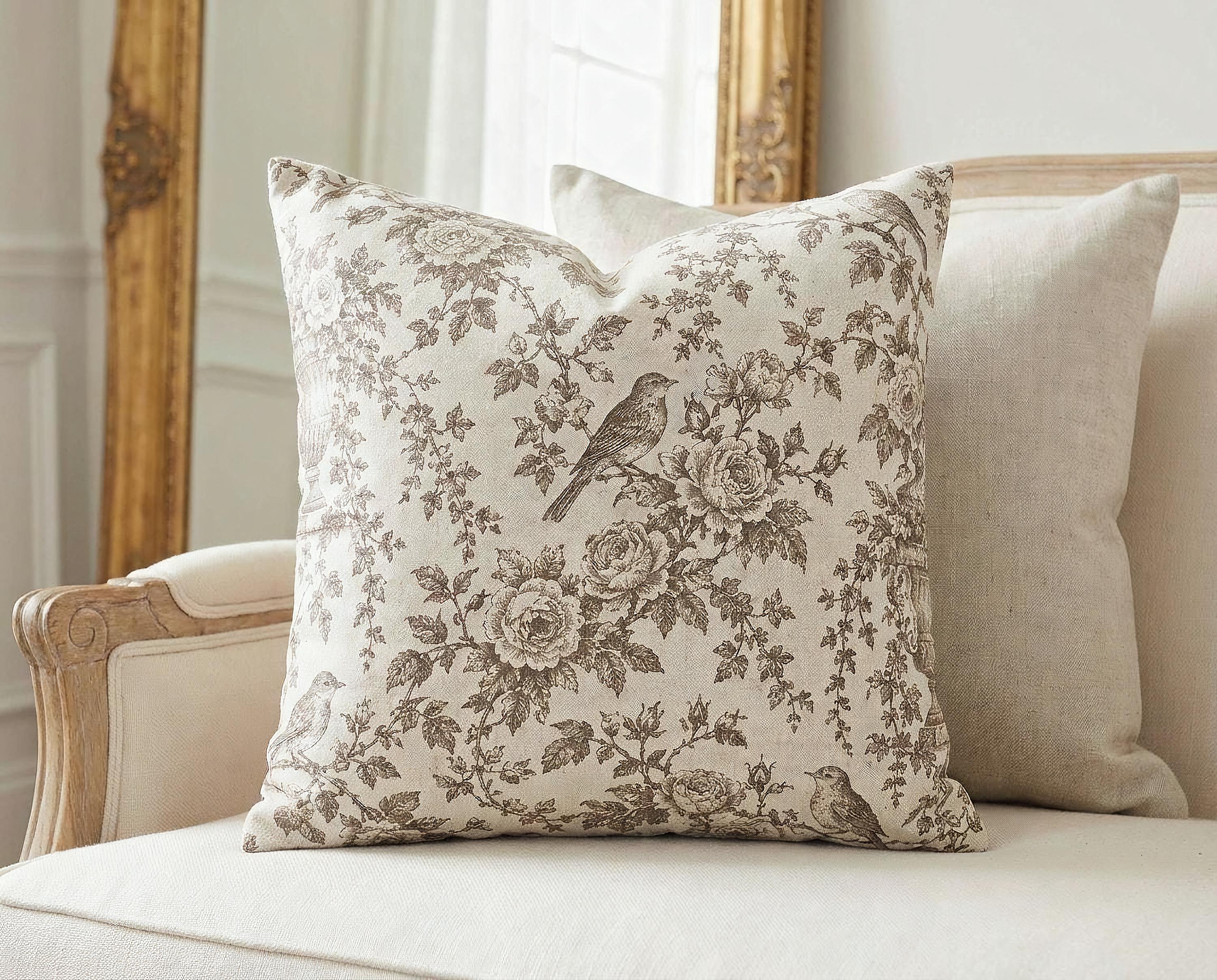
The Antique Bird and Rose toile cover works as that anchor because its songbirds, climbing roses and garden urns sit in warm sepia taupe on cream. It sets the palette for everything else.
How to Mix and Match Pillow Patterns Without Clashing
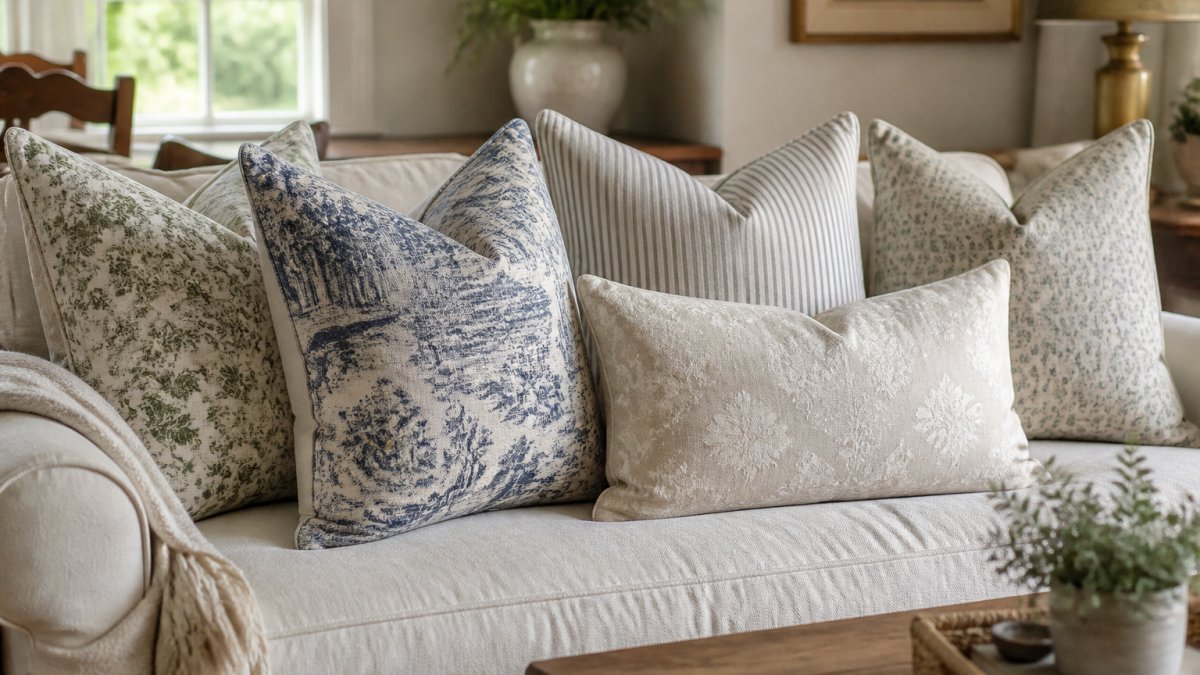
The safest pattern-mixing rule for a French cottage sofa is one large print, one medium print, and one small or solid piece. Some styling guides take this further by balancing solids, geometrics, and florals across a couch.
Designers also often warn against matching sets, since overly coordinated arrangements can look flat while blended textures and patterns add depth.
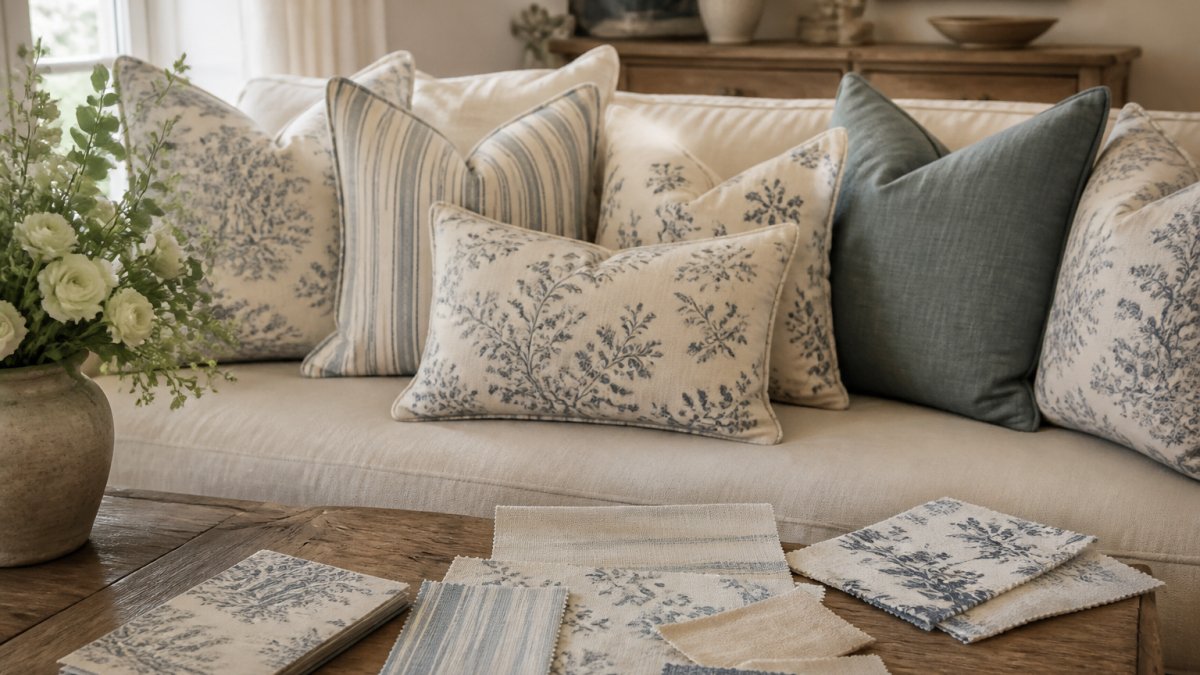
What most guides skip is scale, the actual size relationship between prints. Toile scenes read as a large-scale print because the motif repeats across a wide area, so it needs partners that are clearly smaller. A workable starting ratio is roughly 3:2:1, the toile motif at its widest point, a medium print about two-thirds that size, and a small print or stripe about one-third. If your toile scene spans a hand's width across the cover, look for a damask or medallion whose repeat is noticeably smaller, and a ticking stripe or gingham whose repeat is smaller still.
Try this order:
- Lay the toile down first as your large-scale print.
- Add a damask or floral medallion at medium scale, its repeat should be visibly smaller than the toile scene.
- Finish with a ticking stripe or a solid for breathing room.
- Repeat one color three times so the mix feels intentional.
Watch out: two prints at the same scale fight each other even when the colors match. If a floral and a toile look similarly busy from across the room, one of them is the wrong size, not the wrong color.
Color is the second lever. Keep the toile's ground color as the shared thread, a sepia toile on cream pairs cleanly with a cream damask and a warm greige solid, because all three sit on the same light base. Introducing a second strong ground (a navy toile beside a black-and-white stripe, for example) splits the arrangement into two stories.
If you want a deeper walkthrough of combining prints, our guide on mixing pillow patterns without clashing covers the full method.
Best Pillow Combinations for Neutral Sofas
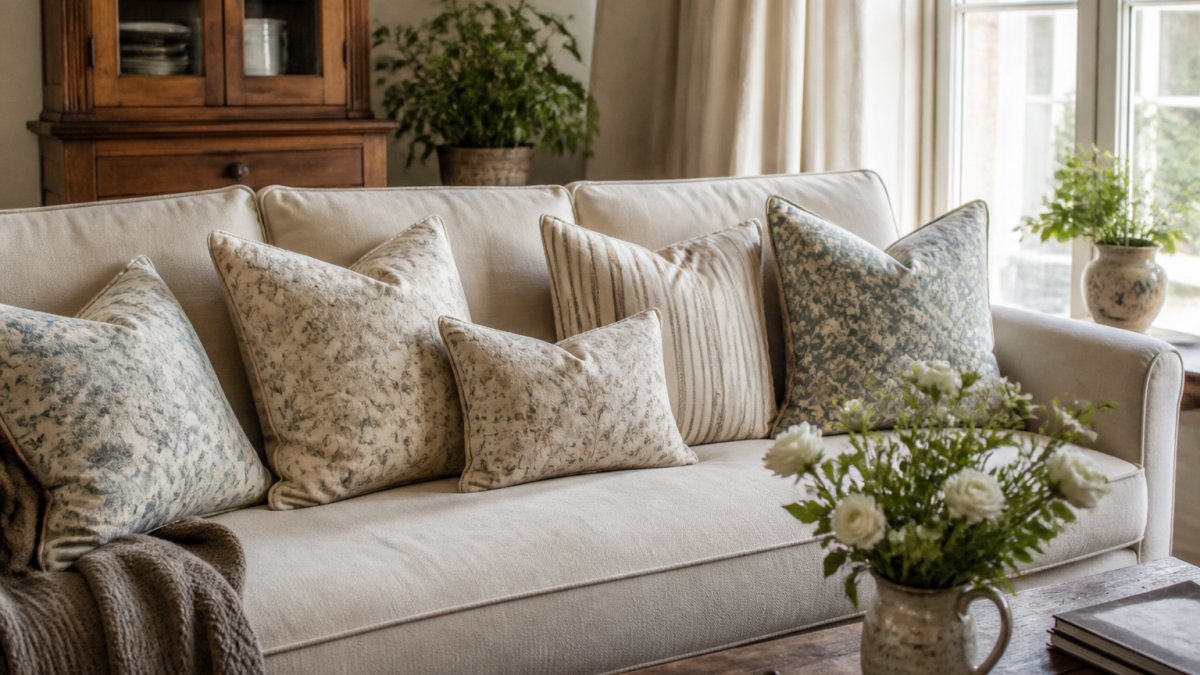
Neutral sofas are the easiest base for vintage toile, because cream and greige let a sepia print glow instead of compete. The best pillow combinations for neutral sofas pair one toile, one damask, and one solid in the same warm family.
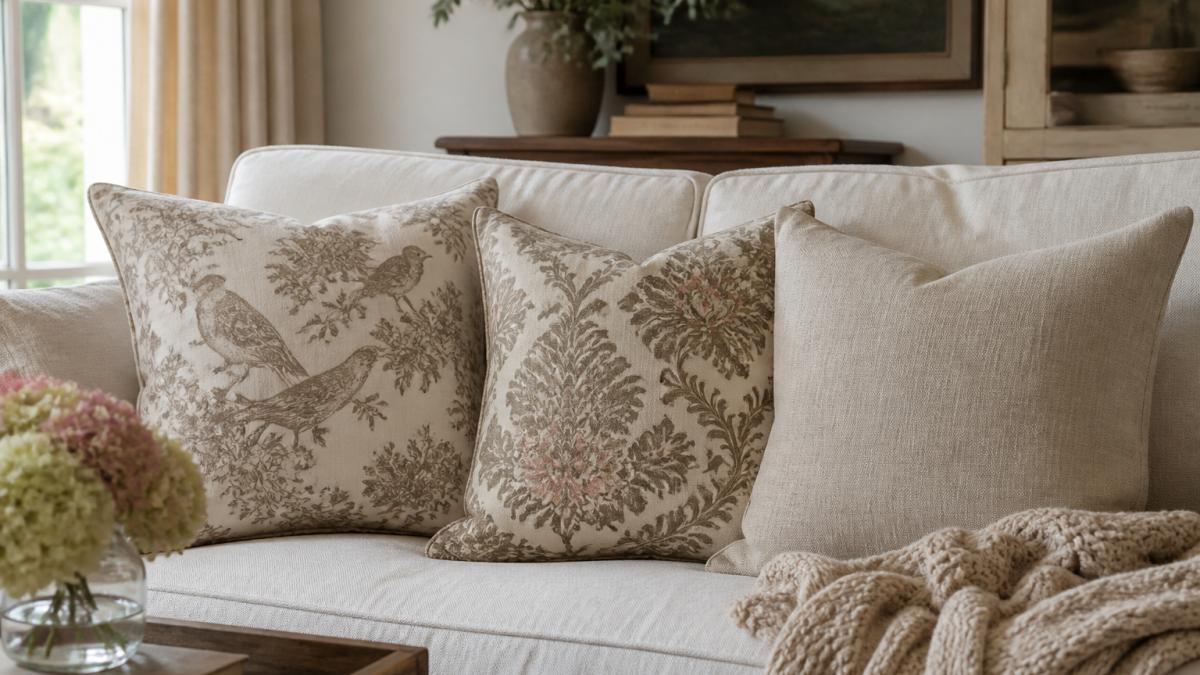
Our favorite pairing for a cream or oatmeal couch:
- Toile first: the bird and rose print in antique taupe.
- Damask second: a floral medallion in the same neutral range.
- Solid third: a warm greige to rest the eye.
The solid oatmeal cover is the companion piece we reach for most. Its soft linen-look texture sits quietly behind a toile and keeps the arrangement from feeling busy.
Styling French Cottage Throw Pillows With Texture and Trim
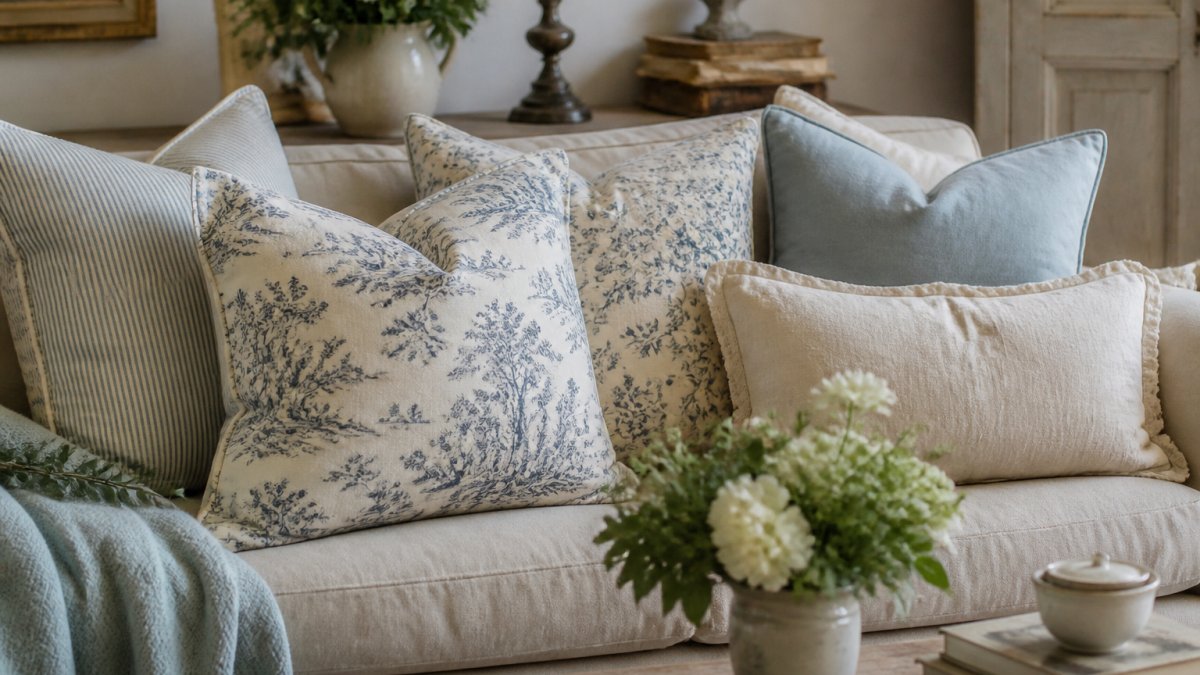
Styling French cottage throw pillows comes down to texture, not more pattern. Toile is flat and printed, so it needs soft neighbors: a nubby knit, a quilted cover, a linen-look solid, or a simple ruffled edge.
Statement pillows are a popular decor trend, and texture is what makes a statement read as collected rather than store-bought.
Layer in this order:
Taupe Toile Pillow Cover, Antique Bird and Rose Toile de Jouy Throw Pillow →
- Start with the largest, plainest cover at the back.
- Add the toile in the middle for the focal point.
- Finish with a small textured or trimmed accent in front.
- Mix one smooth finish with one nubby finish per seat.
A quilted or trimmed accent adds textural depth without adding another competing print. That contrast is what makes a cottage room feel lived in.
Get the Scale and Proportion Right on Every Seat
Scale is where most pillow arrangements fail. A large toile on a small loveseat swallows the seat, while tiny pillows vanish on a deep sofa. Match the pillow size to the furniture, then vary the sizes within the group.
Use this quick guide:
| Seat Type | Pillow Count | Size Mix |
|---|---|---|
| Loveseat | 3 | One large, two medium |
| Standard sofa | 5 | Two large, two medium, one small |
| Sectional | 6-7 | Two large, three medium, two small |
| Accent chair | 1-2 | One medium, one small |
The rule we follow: the largest pillow should span roughly two-thirds of the seat's back height. Odd numbers look more natural than pairs, and one small accent in front of a large toile creates depth.
Check Fabric Weight and Authenticity Before You Buy
Fabric weight and print quality decide whether a toile cover lasts or pills after a season. A good printed toile has a tight, even print with no blurring, a soft linen-look hand, and a sturdy backing. Heavier fabric holds its shape better on a sofa that gets daily use.
The harder question for many buyers is telling a genuine vintage toile from a modern reproduction. A few practical checks help:
- Look at the repeat. True vintage toile was printed from engraved copper plates, so the scene repeats with fine, continuous linework. Modern reproductions often show slightly thicker lines or a visible dot pattern up close.
- Check the ground. Older toile grounds tend to be a warmer, slightly uneven cream; new reproductions are usually a flat, bright white.
- Feel the hand. Genuine vintage cotton has softened with age and drapes loosely. New printed covers feel crisper and more uniform.
- Inspect the seams and backing. A hidden zipper and a full back panel signal a modern cover made to be used, not an antique panel.
Before you buy, check these points:
- The print is crisp, not faded or smeared at the edges.
- The listing says printed, not woven, unless it is a true tapestry.
- The cover has a hidden zipper and a full back panel.
- The fabric feels substantial, not papery.
- Care instructions are clear and realistic for your household.
Watch out: a listing that calls a printed cover "vintage" is describing the style, not the age. If authenticity matters to you, ask the seller directly whether the piece is an antique textile or a new print.
For a closer look at what holds up over time, read our guide on choosing durable decorative pillow fabrics.
Refresh the Look With Seasonal Toile Pillow Cover Swaps
Seasonal swaps are the cheapest way to revive decor without repainting a room. Warm seasonal tones such as rust, terracotta, camel, and sage pair beautifully with traditional toile.
Swap two pillows, not the whole sofa. In fall, add rust or camel solids beside your taupe toile. In winter, bring in a cranberry toile and a red gingham for a cottage holiday look. In spring, trade the warm solids for sage and cream.
Our coordinated Christmas toile set takes the guesswork out of the holiday swap with a snowy village toile, a red gingham, and a forest green piece that already work together.
Build Your Toile Pillow Cover Collection at Ivy & Linen
Building a collection slowly beats buying a matching set in one order. Start with one toile anchor, add a solid companion, then layer a seasonal accent each year. That approach keeps a room looking collected, and it lets you test how a print reads in your own light.
Watch out: buying five pillows at once in the same pattern is the fastest route to a flat, showroom look.
Our printed covers come in vintage-inspired toile, floral block prints, ticking stripes, and damask designs, designed to mix across collections. Start with one anchor piece, then add a companion solid and a seasonal accent as your room evolves.
Frequently Asked Questions
What patterns pair well with vintage toile pillow covers?
Toile works best beside patterns that differ in scale and type. Pair a large-scale toile pillow cover with a small ticking stripe, a quiet floral print, or a solid textured linen. A widely shared 2026 styling formula suggests balancing two solids, two geometrics, and three florals or toile-style covers on a sofa. Keep the color family tight, such as taupe and cream or slate blue and ivory, so the patterns read as collected rather than chaotic.
How do I mix and match pillow patterns without clashing?
Pick one anchor pattern first, usually your toile, then build around it. Vary scale so one pattern is large and the next is small, and repeat one color across every pillow. Designers quoted in 2026 note that matching sets can look too uniform, so blend textures and patterns instead. A simple test: squint at the arrangement. If the pillows blur into one tone, add contrast; if they compete, swap one for a solid.
How many pillows should I use on a standard sofa?
Most sofas look balanced with three to five pillows. For a two-seat sofa, try one toile pillow cover on each end plus a solid in the middle. On a three-seat sofa, the 2-2-3 pattern mix from 2026 trend reports gives a good starting point: two solids, two geometrics, and three floral or toile covers. Fewer, larger pillows often look more refined than a crowded row of small ones.
Are toile pillow covers suitable for a modern farmhouse look?
Yes. Toile's softened color palettes, trailing florals, and faded grounds fit the vintage aesthetic that 2026 style guides define as collected rather than mass-produced. On a modern farmhouse sofa, keep the palette neutral with taupe, oatmeal, or slate blue toile and add one ticking stripe or solid for contrast. The mix of old-world print and clean lines is what keeps the room from feeling like a themed set.
Ready to anchor your French cottage look? Get started with Ivy & Linen and build a toile collection that layers beautifully season after season.